 (+035) 527-1710-70
 google@gmail.com
 Choose an address

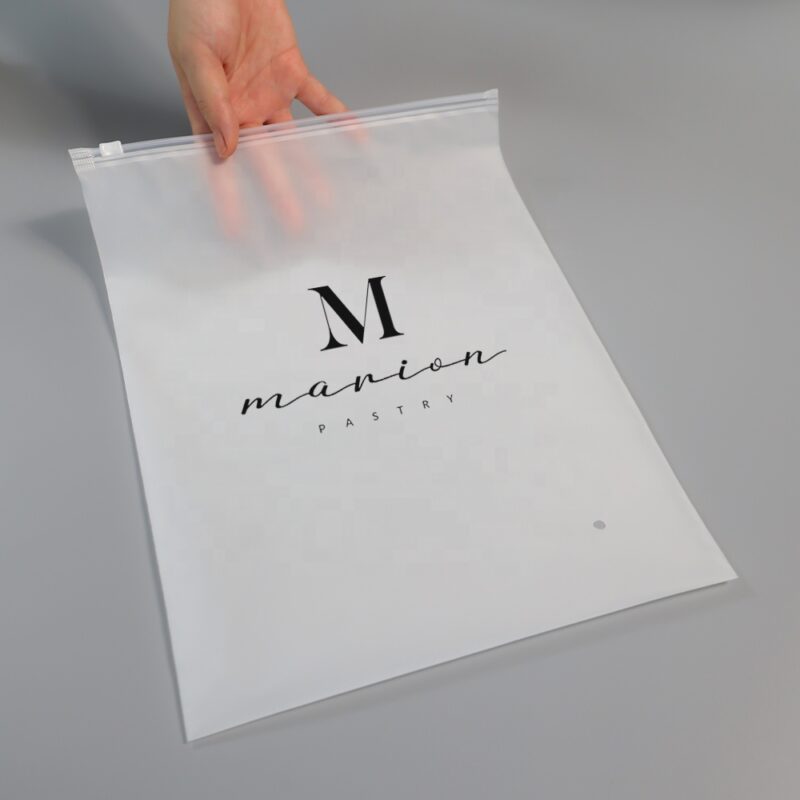
A frosted CPE clothing zipper bag is a soft, semi-translucent garment bag with a slider zipper. It protects folded clothing, reduces scuffing during handling, and gives apparel a matte, boutique-style presentation. It is best used as inner packaging or a retail presentation layer—not as a standalone carrier mailer, food pouch, or high-barrier protective package.
Quick Answer
What Does “CPE” Mean on Clothing Bags?
In garment packaging, “CPE” most often refers to chlorinated polyethylene, a soft plastic film related to polyethylene. The material is valued for its flexible feel, frosted appearance, and resistance to surface scuffs.
However, buyers should not rely on the abbreviation alone. Some suppliers use “CPE” to mean cast polyethylene rather than chlorinated polyethylene. These may have different material properties, recycling implications, compliance considerations, and chemical composition.
For that reason, the resin should always be written clearly in the purchase order:
A clear purchase-order line could read:
Material: chlorinated polyethylene film; frosted finish on both sides; slider zipper closure; 65 microns per layer.
CPE vs standard clear PE
Frosted CPE is especially useful when a brand wants packaging that looks intentional without fully exposing every fold, label, or crease inside the bag.
CPE Clothing Bag Size Guide
The right bag size depends on the garment’s folded length, folded width, thickness, and structure. The safest rule is to select a bag that leaves approximately 2–3 cm of room on each side of the folded garment.
This extra space helps the zipper close smoothly, reduces seam stress, and makes warehouse packing faster.
Common apparel size recommendations
Fit-check rule for sampling
Before placing a bulk order:
Fold the garment exactly as it will be packed.
Measure the folded length, width, and approximate thickness.
Add 2–3 cm to the length and width.
Insert the garment into a physical sample bag.
Close the zipper without pulling or forcing the seams.
Test the bag after handling, stacking, and carton packing.
Structured blazers, padded coats, quilted jackets, and down garments should always be tested physically. Their folded volume can vary significantly even when the garment label size is the same.
Recommended Thickness for Frosted CPE Bags
For standard T-shirts, tops, and lightweight apparel, frosted CPE zipper bags commonly use film in the range of 60–70 microns per layer.
That equals:
The most important detail is whether the supplier is quoting thickness per film layer or for both sides combined.
A zipper bag has a front panel and a back panel. If a supplier says “0.14 mm total,” that may mean two 0.07 mm layers rather than one 0.14 mm sheet.
Practical thickness selection
Thickness is not the only quality measure
A thicker bag is not automatically a better bag. Bag performance also depends on:
Film formulation and softness
Zipper construction
Heat-seal strength
Side-seal width
Vent-hole position and diameter
Printing coverage
Carton stacking conditions
Garment weight and bulk
Extra thickness increases material cost, freight weight, and storage volume. For a lightweight T-shirt, an unnecessarily thick bag may add cost without improving the customer experience.
A useful cross-check is bag weight. For example, a 25×35 cm frosted zipper bag at around 60 microns per layer may weigh roughly 12–13 g per piece, although the actual result changes with the zipper, vent hole, film density, and printing coverage.
Logo Printing on Frosted CPE Bags
Yes, frosted CPE clothing zipper bags can be printed with a logo, text, care message, QR code, size mark, or full brand pattern. Printing can usually be placed on the front, back, or both sides.
The best results come from artwork designed for the frosted surface rather than artwork copied directly from a paper hangtag or website banner.
Artwork that works well
Bold wordmarks
Solid icons
Large monograms
One- or two-color logos
Simple geometric patterns
High-contrast brand blocks
Large QR codes with adequate quiet space
Clear care or handling instructions
Artwork that needs testing
Hairline text
Fine outlines
Small serif lettering
Detailed illustrations
Photography
Gradients
Soft shadow effects
Very small QR codes
Multi-color artwork with tight registration
Because frosted CPE diffuses light, very fine design details can look softer than they do on glossy clear plastic. A logo that appears crisp on white paper may look less defined on a matte translucent bag.
Recommended color combinations
Always request a printed sample before authorizing bulk production, especially if the packaging includes metallic ink, large solid-color coverage, fine text, or a QR code.
Why Fashion Brands Choose CPE Zipper Bags
Fashion brands use frosted CPE bags because they combine protection, presentation, and practical handling in one package.
A clear polybag performs the basic protective function. A frosted CPE zipper bag adds a more refined unboxing layer while still allowing the customer to identify the general contents.
Best applications
Frosted CPE zipper bags are a strong fit for:
Streetwear brands
Boutique T-shirt brands
Uniform suppliers
Wholesale apparel distributors
Hoodie and sweatshirt collections
Outerwear packaging
Promotional clothing packs
Gift sets and coordinated garment bundles
Private-label apparel suppliers
Subscription clothing packaging
They are particularly useful for brands that want a consistent branded appearance across product categories without moving to rigid boxes or expensive custom cartons.
CPE vs Clear PE vs PEVA
Choose frosted CPE when
You want a matte, premium-looking package.
Your brand logo is bold and simple.
You need a reusable slider zipper.
Full garment visibility is not essential.
You want to reduce the visual impact of wrinkles and warehouse scuffs.
The bag will serve as an inner packaging layer inside a mailer or carton.
Choose clear PE when
Cost control is the main priority.
Customers or warehouse staff need to see the product clearly.
Packaging is primarily functional rather than presentation-focused.
The garments are used in large-volume, general distribution systems.
Choose PEVA when
Product color and texture must be highly visible.
The collection is retail-display focused.
The brand has a PVC-free or chlorine-sensitive sourcing policy.
You are packaging bridalwear, colorful fashion, delicate textiles, or color-critical collections.
Pros and Cons of CPE Clothing Zipper Bags
Pros
Soft, matte appearance that can feel more premium than standard clear polybags
Helps hide garment wrinkles, folds, and minor surface scuffs
Slider zipper makes the bag easy to open and reuse
Suitable for custom logos, simple artwork, and brand messages
Available in a wide range of sizes for T-shirts, hoodies, jackets, and accessories
Supports cleaner warehouse organization and garment protection
Can act as a branded unboxing layer inside an outer shipping package
Cons
Less transparent than clear PE or PEVA
Not a tamper-evident or carrier-safe shipping package
Chlorinated polyethylene may conflict with chlorine-free sourcing rules
Supplier terminology can vary, especially around “CPE” resin definitions
Fine printing details may not reproduce as sharply on frosted film
Recycling claims should not be printed without checking destination-market collection rules
Bulkier zipper bags may take more carton space than standard flat polybags
When a CPE Zipper Bag Is the Wrong Choice
A frosted CPE zipper bag is not the right packaging solution in every situation.
Important shipping rule
A CPE zipper bag should normally be treated as the inner package. The bagged garment should then go inside:
A sealed poly mailer
A kraft mailer
A corrugated shipping carton
A reusable shipping bag with a tamper-evident seal
The zipper closure is useful for reusability and presentation, but it is not a substitute for a shipping seal.
CPE Clothing Bag Specification Checklist
A clear order specification reduces sample disputes, production errors, and misunderstandings about thickness or material.
Example specification line
Frosted CPE slider zipper garment bag, 25×35 cm, 65 microns per layer, frosted both sides, white semi-translucent finish, 6 mm round vent hole, front logo in one-color black screen print, packed 100 pieces per bundle and 1,000 pieces per export carton.
Frequently Asked Questions
Is a CPE zipper bag better than a clear PE bag for a T-shirt brand?
CPE is usually better when presentation matters as much as basic protection. Its frosted matte finish looks more premium, helps hide folded-garment creases, and works well with bold brand logos.
Clear PE is usually the more economical option when full garment visibility is important. If customers need to see the exact color, print, fabric texture, or fold of the T-shirt before purchase, clear PE or PEVA may be more suitable.
What CPE bag size fits a hoodie?
A 30×40 cm bag can fit many standard hoodies, while 35×45 cm is the safer choice for heavyweight fleece, oversized silhouettes, zip hoodies, or folded hoodie-and-pants sets.
If the garment feels tight when folded into the sample bag, move up one size rather than forcing the zipper shut.
What CPE bag size fits a folded jacket?
A 40×50 cm bag is a common starting size for jackets, windbreakers, and moderate down jackets. Thick padded coats, long outerwear, or bulky winter styles may need 40×60 cm or 45×50 cm.
Always test a physical sample with the final folded garment, including hangtags, tissue paper, accessories, and any insert cards.
Can a frosted CPE zipper bag be used for shipping?
Not by itself. A frosted CPE zipper bag works well as inner packaging, but it is not a tamper-evident carrier mailer. The garment should be placed inside a sealed poly mailer or shipping carton for transit protection.
Can a CPE clothing bag have a custom logo?
Yes. Logos can be printed on one or both sides. Bold logos, simple icons, large text, and one- or two-color artwork usually deliver the strongest result on frosted film.
For detailed graphics, metallic effects, small type, gradients, or QR codes, approve a printed sample before bulk manufacturing.
Are CPE bags suitable for brands with PVC-free or chlorine-free policies?
They may not be suitable if the CPE film is chlorinated polyethylene. A chlorine-free policy can conflict with a chlorinated resin, even if the product is marketed as a “CPE bag.”
Ask the supplier for a resin declaration and review the retailer’s material policy before production. PE, PEVA, or another approved non-chlorinated material may be a better option.
Can “recyclable” be printed on a CPE garment bag?
Do not print a recycling claim unless local recycling acceptance has been verified for the destination market. A material may be technically recyclable while still not being accepted in common household recycling streams.
The safest approach is to confirm the local waste-management rules, retailer policy, resin composition, and any required labeling before printing environmental claims.
Final Takeaway
Frosted CPE clothing zipper bags are a practical choice for fashion brands that want garment protection with a more polished, branded presentation than a standard clear polybag. For most T-shirts, begin with 25×35 cm and about 60 microns per layer; for hoodies, use 30×40 cm or 35×45 cm; for jackets, start with 40×50 cm.
The most important buying decisions are not only size and price. Confirm the exact resin definition, clarify whether thickness is quoted per layer or combined, test a real folded garment, approve a printed sample, and use the zipper bag as an inner package inside a sealed shipping mailer or carton.