 (+035) 527-1710-70
 google@gmail.com
 Kies een adres

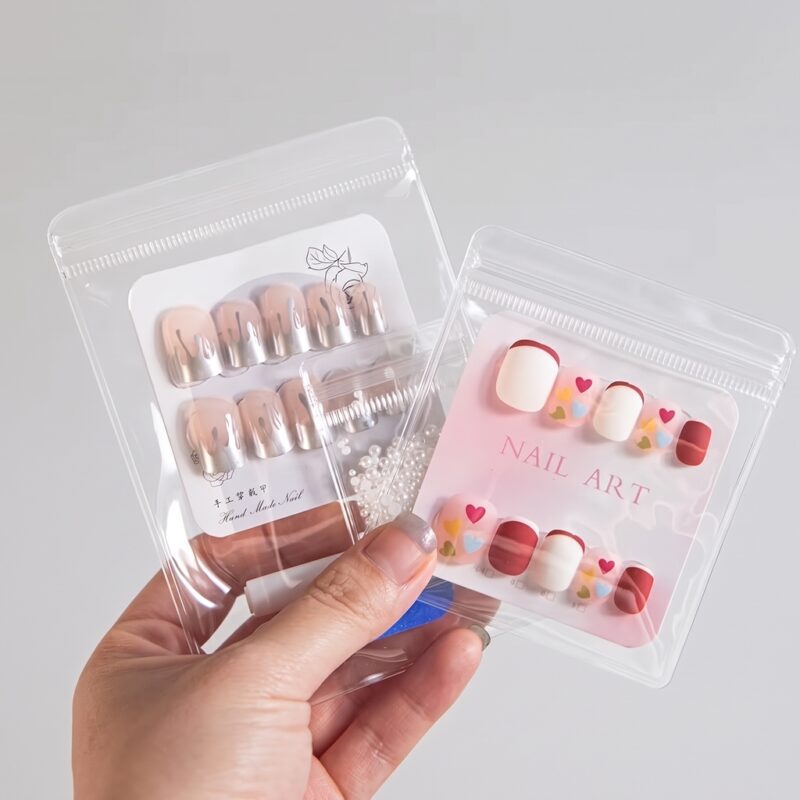
The right custom ziplock size is the inside cavity left after the zipper header and side seams, not the width on a factory chart. A pouch listed as 10×15 cm often leaves only about 9.4×12 cm once a 25–30 mm header is removed, so a product “smaller than the bag” still will not close.
What Should I Measure Before I Request a Custom Size?
Measure the packed unit in millimeters at the widest points, including the cap, hang tag, and insert card. Irregular pieces use the maximum bounding box.
- Soft flat goods (earring card, mask, folded tee): inside width = product width + 10–15 mm; inside length = product length + 10–20 mm.
- Rigid items (vial, tin, cased USB): add another 12 mm (~½ inch) to the width so the item does not pry the track open.
- Bulky kits: add full product depth to both width and length. Add 10–15% more only when the pouch should look full.
- Outside length = inside length + header. Budget ~25 mm of header on jewelry pouches and 30–40 mm on cosmetic or garment pouches. Product cannot sit in that band.
A 100 ml bottle at 45×45×120 mm plus a 2 mm card needs 102 mm inside width (45+45+12) En 180 mm inside length (120+45+15). A 30 mm header makes the order about 110×210 mm. A stock 10×15 cm jewelry pouch will not close around that bottle.
Gusset only when the product must stand. Sets of 100–300 ml commonly use an 18×24 cm pouch with a 60–80 mm bottom gusset. A gusset on a 6×8 cm earring bag only adds wrinkles. State that width is the zipper side; a swapped width puts the track on the short edge.
Which Film — PVC, EVA, or TPU — Changes the Size?
Stiffness changes clearance. Flexible PVC density commonly sits near 1.2–1.4 g/cm³. EVA density sits near 0.93 g/cm³, so EVA weighs less at the same gauge. TPU stretches instead of holding a boxy shape.
| Decision | PVC | EVA | TPU |
|---|---|---|---|
| Polymer | Plasticized polyvinyl chloride | Ethylene-vinyl acetate copolymer | Thermoplastic polyurethane |
| Look and hand | Clearest; shelf-stiff at 0.15–0.40 mm | Frosted to clear; soft. Padded sheet often 0.5–1.8 mm | Duidelijk, soft, elastisch |
| Cold freight | Stiffens near 0°C; can crack | Stays flexible in winter transit | Many grades flex near −30°C to −40°C |
| Usual gauge | 0.10–0.35 mm retail; naar 0.80 mm if structured | 0.12–0.20 mm garment film, or thick sheet | 0.15–0.50 mm |
| Cost and fit | Laagste kosten; cut closer | Often 10–20% above PVC; add 5–10 mm width | Highest cost; keep ≥10 mm clearance |
| Weak fit | Geur, phthalate paperwork, sub-zero freight | Swimming, sharp hardware, glass clarity | Penny-driven mass runs; rigid window-box look |
PVC fits jewelry, hang-sell cosmetics, briefpapier, and clear stadium bags. EVA fits frosted apparel and storage and skips the liquid plasticizers PVC needs; EVA fails for crystal clarity or swimming. TPU fits welded phone and cosmetic pouches in the cold and will not mimic a stiff PVC box.
How Thick Should the Wall Be?
Walls under 0.10 mm (about 4 miljoen, of 100 micron) crack at the fold after repeated zipper cycles. That split shows up in weeks.
| Product | Practical gauge | Usual film |
|---|---|---|
| Oorbellen, beads, ≤30 ml vial | 0.12–0.20 mm (~5–8 mil) | PVC, or frosted EVA |
| Cosmetic pouch, 30–100 ml | 0.18–0.25 mm | PVC or thin EVA |
| Toiletry set, 100–300 ml | 0.25–0.35 mm PVC, or 0.6–1.0 mm EVA sheet | Clear PVC or padded EVA |
| Folded garment or towel | 0.05–0.16 mm (50–160 microns) | EVA or PEVA |
| Splash phone pouch, not diving | 0.15–0.18 mm, RF-welded | TPU or PVC |
| Structured tote | 0.30 mm; 0.50 mm+ to stand empty | PVC, or TPU in the cold |
| Keys, sharp hardware | 0.30 mm+ or heavy PE | Not 0.15 mm jewelry film |
One mil is 0.001 inch: exactly 0.0254 mm en 25.4 micron. Eight mil and 0.20 mm are the same wall. Reusable EVA storage is often 0.5–1.8 mm, so “0.20 mm EVA” and “0.20 mm PVC jewelry film” are different products. Write millimeters. “Gauge” is ambiguous; some markets treat 100 gauge as 1 miljoen.
Does the Zipper Eat the Size?
Match the track to the film or the seal peels: PVC on PVC, EVA on EVA, PE only on PE or a PE sealant. Press-to-close suits pouches under about 20 cm wide. A slider often consumes ~20 mm and must still clear the product. Double-track suits powders and uses more header.
A retail ziplock is not an IP rating. IEC 60529 IPX7 means 1 meter for 30 minutes; IPX8 is deeper or longer, as the maker defines it. Submersion needs a waterproof zipper or roll-top plus welded seams. PVC and TPU high-frequency welds commonly run at 27.12 MHz. Stitched seams without tape leak. EVA foam handles rain and is wrong for swimming.
Which Products Should Not Use These Bags?
Food contact needs a declaration for that film, ink, and zipper under FDA rules or EU 10/2011. A cosmetic PVC/EVA/TPU pouch is not that document. A normal zipper is not child-resistant under 16 CFR 1700. Children’s goods also face the CPSIA 0.1% phthalate limit and, if the bag is the toy, EN 71-3.
REACH Annex XVII Entry 51, amended by Regulation (EU) 2018/2005, restricts DEHP, DBP, BBP, and DIBP at or above 0.1% by weight of the plasticised material in EU articles after 7 juli 2020, with exemptions. The entry names PVC and polyurethanes, so test the finished bag, including ink. EVA and TPU usually avoid those four phthalates. PVC complies only with a non-phthalate plasticizer plus that test. Voorstel 65 is a California warning duty, not a ban.
Sharp parts over a few hundred grams, oven heat, and months of outdoor UV sit outside this format. EVA softens in a hot car, PVC can bloom and smell, and TPU yellows unless UV-stabilized. Most cities accept none of the three at the curb.
What Should the Quote Lock So the Size Cannot Drift?
- 15 ml dropper, 28×28×78 mm, plus a 60×90 mm card
- 70 mm inside width × 120 mm inside length below the zipper; 150 mm outside length with a 30 mm header; zipper on the width
- Crystal PVC 0.18 mm ±0.02 mm, non-phthalate — or frosted EVA 0.15 mm
- Matching press-to-close track; heat seal, or RF weld for a short water dip. No IPX claim without a waterproof zipper
- One-color screen, minimum line 0.7 mm, Pantone named; EU phthalate test on the finished bag; no food-contact claim
- Jewelry customs often start near 100–1,000 pieces; padded EVA and gravure often start at 5,000–20,000. Samples commonly take 5–9 working days; bulk 15–30 after approval
Trial two films when winter freight points to EVA or TPU and unit cost points to PVC. A few hundred samples cost less than a wrong 50,000-piece lot.
Choose PVC to show the product in a structured pouch at the lowest gauge cost. Choose EVA to stay soft in cold transit, skip phthalate plasticizers, or look frosted. Choose TPU for a reusable waterproof pouch when the budget covers the resin. Size from the bounding box plus depth, add the header, and write the wall in millimeters so 0.20 mm en 8 mil cannot be confused.
Veelgestelde vragen
Should I choose EVA or PVC if the custom ziplock ships in winter?
EVA is the safer film when any leg of the trip sits near freezing. Standard pouch-grade PVC, often 0.10–0.18 mm, stiffens around 0°C and can crack in an unheated container, while EVA stays flexible and is lighter because density sits near 0.93 g/cm³ versus about 1.2–1.4 g/cm³ for flexible PVC. TPU is the upgrade when that same route also needs a soft reusable pouch, at a higher resin price. PVC still fits a warm, domestic, cost-driven run if a finished-bag phthalate report is acceptable. EVA foam will not turn that winter bag into a swim pouch.
Why doesn’t my product fit a ziplock that is larger than the product on the size chart?
The chart number is usually the outside cut, and the zipper header is not storage. Jewelry headers run about 25 mm, and cosmetic or garment headers often run 30–40 mm, so a 10×15 cm pouch may leave only about 12 cm of usable length. A rigid bottle also needs its depth added to width and length, plus about 12 mm so the item does not force the track open. A 45×45×120 mm bottle therefore wants about 110×210 mm, not a 10×15 cm jewelry bag. Order the inside length below the zipper, and define width as the zipper side.
Is a TPU ziplock more waterproof than a PVC ziplock for a phone or makeup pouch?
Neither film is waterproof until the seam and the zipper are. PVC and TPU are both waterproof materials, but a standard press-to-close track is only splash-resistant and does not meet IEC 60529 IPX7, which is 1 meter for 30 minutes. IPX7 or IPX8 needs a waterproof zipper or a roll-top plus a weld, commonly high-frequency welding at 27.12 MHz, on about 0.15–0.18 mm film for a phone pouch. Choose TPU when the pouch must stay soft below freezing. EVA sheet handles rain and is the wrong spec for swimming.
Can I put snacks or supplements in a PVC, EVA, or TPU jewelry ziplock?
Nee, unless that exact film, ink, and zipper carries a food-contact declaration. Jewelry and cosmetic pouches are built for clarity and hand feel, not for FDA food contact or EU Regulation 10/2011. Oils and supplements can pick up plasticizer or ink even when the wall looks clear, so those products belong in a food-grade PE or other certified food-contact structure. The same limit applies to safety closures: a normal zipper is not child-resistant under 16 CFR 1700.
What size and thickness should I use for earrings versus a toiletry kit?
Earrings and beads usually fit a flat pouch around 6×8 cm to 9×13 cm at 0.12–0.20 mm, in crystal PVC or frosted EVA. A 30–100 ml cosmetic pouch is commonly 0.18–0.25 mm, while a 100–300 ml set that must stand is closer to 18×24 cm with a 60–80 mm gusset, at 0.25–0.35 mm PVC or 0.6–1.0 mm EVA sheet. Film under 0.10 mm splits at the fold after repeated zipper cycles. Garments are the opposite build: large area and thin wall, often 0.05–0.16 mm EVA or PEVA, because extra thickness mostly adds freight.