 (+035) 527-1710-70
 google@gmail.com
 एक पता चुनें

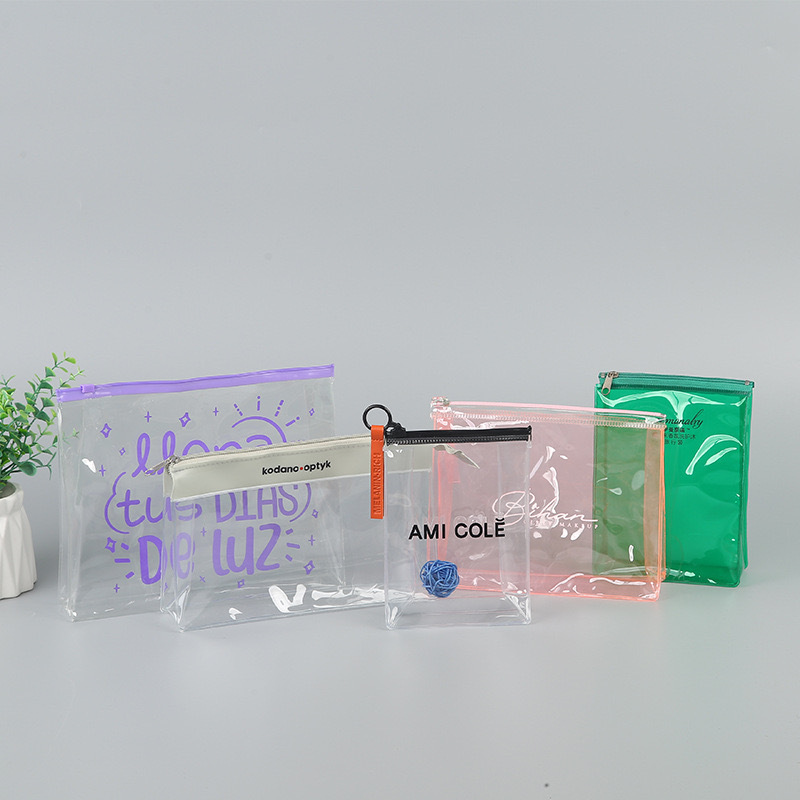
त्वरित जवाब: This poly bag thickness guide helps buyers choose the right mil, mm and material for custom packaging.most custom poly bags land in five bands — 1.5–2 mil (0.038–0.051 mm) पीई for apparel and e-commerce, 3–4 mil (0.076–0.102 mm) पीई for hardware and sharp goods, 0.10–0.16 mm (4–6 mil) पीवीसी या ईवीए for jewelry, cosmetics and toiletry kits, 0.15–0.30 mm (6–12 mil) टीपीयू for waterproof and dry bags, और 0.03–0.06 mm (1.2–2.4 mil) OPP/PP for card sleeves and gift wrap. Thickness is a function of load, edge sharpness and material — not of price alone.
What do “एमआईएल,” “गेज,” और “micron” actually mean on a bag spec sheet?
A mil is one one-thousandth of an inch, not one millimetre — a confusion that causes more rejected shipments than any other spec error in plastic packaging. One mil equals 0.001 inch, 25.4 माइक्रोन, 0.0254 मिमी और 100 गेज. US buyers quote mil; factories in Guangdong, Zhejiang and Vietnam quote mm; European buyers quote microns. A buyer asking for “0.12” while the factory reads “0.12 मिमी” gets a bag roughly 4.7 mil thick — nearly five times the intended weight.
| हज़ार | Gauge | Inch | Micron (µm) | Millimetre (मिमी) |
|---|---|---|---|---|
| 1.0 | 100 | 0.001″ | 25.4 | 0.025 |
| 1.5 | 150 | 0.0015″ | 38.1 | 0.038 |
| 2.0 | 200 | 0.002″ | 50.8 | 0.051 |
| 3.0 | 300 | 0.003″ | 76.2 | 0.076 |
| 4.0 | 400 | 0.004″ | 101.6 | 0.102 |
| 6.0 | 600 | 0.006″ | 152.4 | 0.152 |
| 8.0 | 800 | 0.008″ | 203.2 | 0.203 |
| 12.0 | 1200 | 0.012″ | 304.8 | 0.305 |
| 20.0 | 2000 | 0.020″ | 508.0 | 0.508 |
Film is normally produced to nominal गेज, which permits the web to run up to 10% under the stated figure; ASTM D6988 defines how that thickness is averaged across the web. ए “2 एमआईएल” nominal bag measuring 1.82 mil is inside tolerance. Buyers who need a guaranteed floor must write “full gauge, minimum 2.0 एमआईएल, measured per ASTM D6988” on the purchase order.
How thick should a poly bag be for my product weight?
Weight sets the baseline, and for polyethylene the baseline is well established across the industry.
| Contents | PE thickness | Metric | Typical products |
|---|---|---|---|
| Under 0.5 kg, soft | 1.5 एमआईएल | 0.038 मिमी | टी शर्ट, मोज़े, printed matter |
| 0.5–2.5 kg | 2 एमआईएल | 0.051 मिमी | डेनिम, जूते, bulk apparel |
| 2.5–7 kg | 3 एमआईएल | 0.076 मिमी | हार्डवेयर, fasteners, electronics |
| 7–14 kg | 4 एमआईएल | 0.102 मिमी | Tools, metal parts, auto components |
| 14–23 kg | 6 एमआईएल | 0.152 मिमी | Bulk resin, castings, abrasives |
Three variables override this table. Sharp edges — screws, blades, cast metal — require one to two extra mil regardless of weight, because puncture failure is driven by dart impact resistance (ASTM D1709), not tensile strength. Freezer storage below −18 °C needs 3 mil minimum in LDPE, since crystallinity rises and impact strength falls as temperature drops. Long-haul ocean freight with repeated handling justifies one extra mil over the domestic spec.
PVC vs EVA vs TPU vs PE vs PP — what thickness does each material run at?
Thickness bands differ by material because stiffness, density and clarity differ. गुआंग्डोंग मिंघे पैकिंग औद्योगिक कंपनी, लिमिटेड. runs the following ranges across its blown-film and calendered lines.
| सामग्री | Typical range | घनत्व (g/cm³) | अनुभव करना & स्पष्टता | Best fit | Not suitable for |
|---|---|---|---|---|---|
| पीई (एलडीपीई/एलएलडीपीई) | 1.5–6 mil / 0.038–0.152 mm | 0.92 | कोमल, translucent to clear | परिधान, मेलर्स, industrial liners | Premium retail display |
| पीपी / ऑप | 1.2–2.4 mil / 0.030–0.060 mm | 0.905 | कुरकुरा, glass-clear, rustles | Card sleeves, gift wrap, self-adhesive bags | Impact loads, sub-zero handling |
| पीवीसी | 4–20 mil / 0.10–0.50 mm | 1.30–1.40 | Heavy, supple, high gloss | Cosmetic, toiletry, tote, hanger bags | Food contact; strict phthalate-restricted programs |
| ईवा | 4–24 mil / 0.10–0.60 mm | 0.93–0.95 | कोमल, रबड़ जैसी, frosted or clear | Jewelry pouches, makeup bags, baby goods | Sustained heat above 60 °C |
| टीपीयू | 4–12 mil / 0.10–0.30 mm | 1.15–1.25 | लोचदार, tough, optically clear | Waterproof phone bags, dry bags, RF-welded seams | Lowest-cost bulk packaging |
| सीपीई | 2–5 mil / 0.05–0.12 mm | 0.93 | Matte frosted, quiet | E-commerce apparel mailers | Loads over 3 kg |
ए 4 mil PVC bag and a 4 mil PE bag are not interchangeable. PVC at 0.10 mm carries roughly 45% more resin by weight because of its higher density, holds a rigid shape for shelf display, and accepts RF welding; PE at the same gauge is limp and heat-sealed. TPU at 0.15 mm survives repeated flexing that splits PVC at the same thickness, which is why waterproof phone pouches specify TPU rather than the cheaper alternative.
-

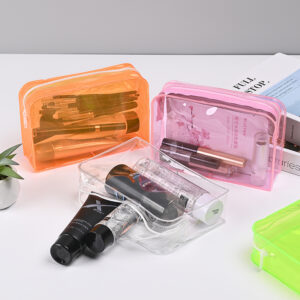
- Thicker PVC (4–20 mil) offers high gloss and rigid shape retention, making it ideal for heavier toiletry and cosmetic kits.
-
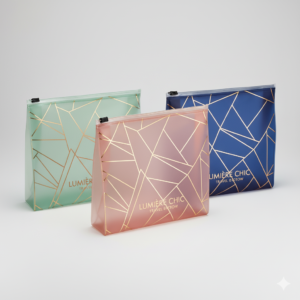
- Frosted EVA provides a soft, rubbery feel and matte finish, perfect for premium cosmetics without the structural stiffness of PVC.
How do I convert thickness into bag weight and unit cost?
Film cost tracks resin weight almost linearly, so thickness is the single largest cost lever after size.
वज़न (g) = Length (सेमी) × Width (सेमी) × 2 × Thickness (सेमी) × Density (g/cm³)
ए 30 × 40 cm LDPE bag at 0.06 मिमी: 30 × 40 × 2 × 0.006 × 0.92 = 13.2 g. The same bag in 0.12 mm PVC: 30 × 40 × 2 × 0.012 × 1.35 = 38.9 g, nearly triple the resin. Moving a 100,000-piece apparel order from 0.06 mm to 0.05 mm PE saves roughly 220 kg of resin — real money at current polyolefin pricing, and a measurable reduction in shipped weight.
What minimum thickness do zippers, sliders and hanging holes require?
Closures impose their own floors, independent of load. A press-to-close ziplock track will not seat reliably below 0.05 मिमी (2 एमआईएल) in PE or 0.10 मिमी (4 एमआईएल) in PVC/EVA, because the extruded profile needs body to hold interlock. Slider zippers need 0.12 mm minimum in PVC/EVA. A euro-slot or hanging hole tears out below 0.10 मिमी unless the panel is reinforced; Minghe specifies 0.14 mm for retail hanger bags carrying 200 g or more.
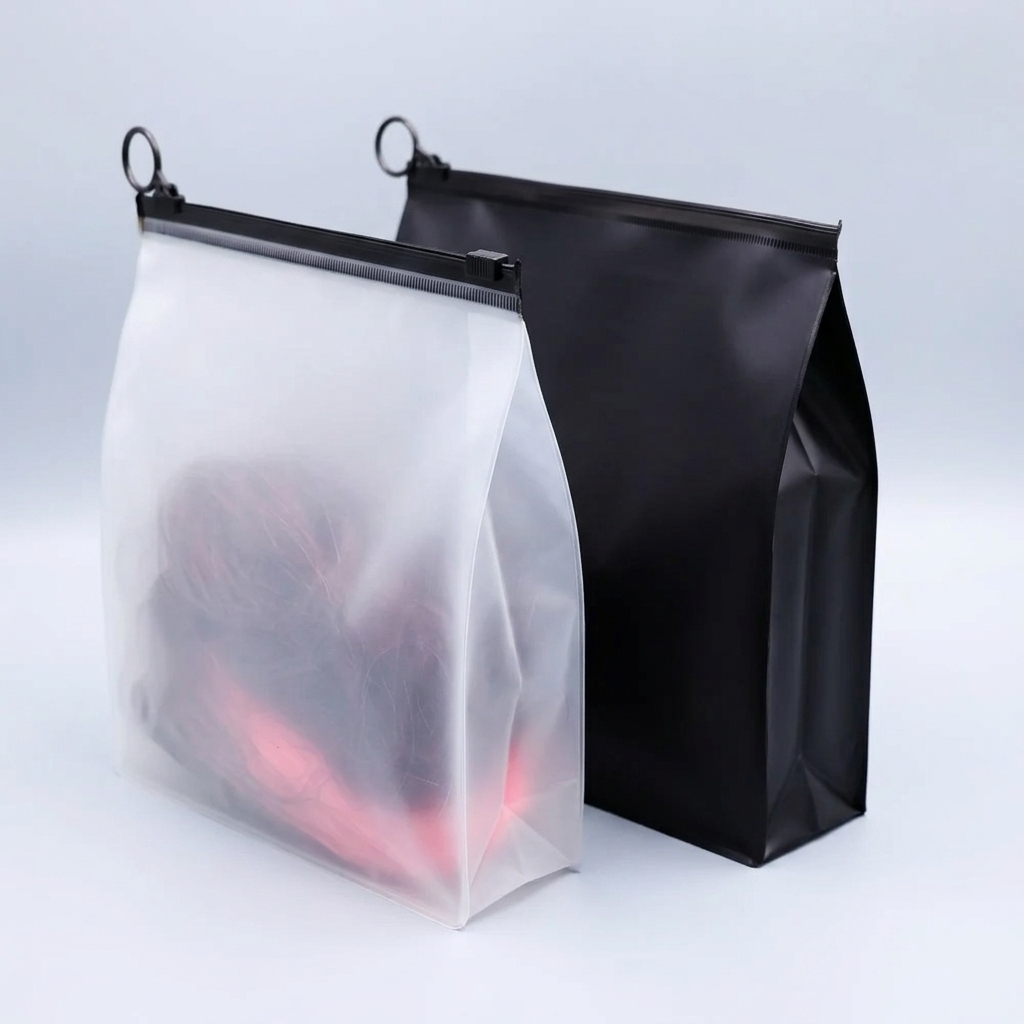
Heavy-duty slider zippers require a minimum film thickness of 0.12 mm to provide enough body for the extruded profile to interlock securely.
What thickness do Amazon, Walmart and US state law force on me?
Marketplace rules set a hard floor of 1.5 एमआईएल. Amazon FBA requires poly bags to be at least 1.5 mil thick, transparent, fully sealed, with a scannable barcode. Bags with an opening of 5 inches or more need a printed suffocation warning. Separately, five US states — California, Massachusetts, New York, Rhode Island and Virginia — plus New York City and Chicago regulate suffocation warnings, and those rules apply to film 1 mil or thinner. Specifying 1.5 mil therefore clears both the marketplace threshold and the state legislation in one decision.
When is a thicker bag the wrong answer?
Over-specification wastes money and fails sustainability audits. ए 4 mil bag around a folded cotton T-shirt adds cost and shipping weight without reducing damage, because soft goods fail by scuffing rather than puncture. Thicker PVC above 0.30 mm becomes stiff enough to crease permanently and crack at fold lines in cold climates. Thicker OPP loses the crisp snap that makes it attractive for gift packaging. And no thickness makes PVC appropriate for direct food contact — that is a material question, not a gauge question, and Minghe specifies PE, PP or food-grade EVA instead.
How to write a thickness spec your factory cannot misread
Four lines eliminate nearly all thickness disputes: state the unit explicitly (“0.12 mm = 4.7 एमआईएल”), state nominal or full gauge, name the test method (ASTM D6988 or ISO 4593), and state the tolerance you will accept (±10% is industry standard; ±5% is available at a premium). Request a pre-production sample measured with a calibrated micrometer at five points across the web. गुआंग्डोंग मिंघे पैकिंग औद्योगिक कंपनी, लिमिटेड. controls thickness in-house across the full chain — resin, उड़ा दी गई फिल्म, मुद्रण, bag making and packing — which is what makes a five-point measurement verifiable rather than a claim from a trading company.
5. FAQ Block (ready to embed)
अक्सर पूछे जाने वाले प्रश्नों
What is the difference between mil and mm on a plastic bag?
A mil is 0.001 inch, while a millimetre is 0.0394 inch — a mil is about 39 times thinner. One mil converts to 0.0254 मिमी, 25.4 microns and 100 गेज. US buyers quote mil, Chinese and Vietnamese factories quote mm, and European buyers quote microns, so a request for “0.12” can be read as 0.12 mil or 0.12 mm — a 47-fold difference in wall thickness. Always write both units on the purchase order.
Is 2 mil poly bag thick enough for shipping clothes?
हाँ, 2 एमआईएल (0.051 मिमी) is the standard spec for apparel shipped in polyethylene and is used across most e-commerce fulfilment. It handles 0.5–2.5 kg without stretching and satisfies the Amazon FBA minimum of 1.5 mil with margin. Step up to 3 mil only if the garment carries hardware such as buckles, zips or studs, or if the shipment involves repeated manual handling. For premium apparel, 0.06 mm frosted CPE gives a better unboxing feel at similar strength.
Which is stronger at the same thickness — PVC, ईवा, TPU or PE?
TPU is strongest at equal thickness, with tensile and tear values several times those of PE, followed by PVC, then EVA, then PE. At 0.15 mm a TPU panel survives thousands of flex cycles in a waterproof phone pouch, where PVC at the same gauge eventually cracks at fold lines. PVC is stiffer and holds shape better for shelf display but is heavier, at a density of about 1.35 g/cm³ versus 0.92 for PE. Choose TPU for flexing and abrasion, PVC for rigid clarity, EVA for softness and phthalate-free compliance.
What thickness do I need for a ziplock or zipper bag?
Ziplock closures require a minimum body thickness of 0.05 मिमी (2 एमआईएल) in PE and 0.10 मिमी (4 एमआईएल) in PVC or EVA, because the extruded track needs film body to hold interlock. Slider zippers need at least 0.12 mm in PVC/EVA. Bags with a euro-slot or hanging hole should run 0.14 mm or thicker when the contents exceed 200 g, otherwise the hole tears out during retail handling. Below these floors, the closure fails before the film does.
Does a thicker bag always mean better quality?
No — thickness beyond what the load requires adds cost and shipped weight without improving protection. Soft goods such as folded apparel fail by scuffing rather than puncture, इसलिए 4 mil around a T-shirt is wasted resin. PVC above 0.30 mm creases permanently and becomes prone to cold cracking, and OPP loses its crisp gift-wrap feel as it thickens. Match thickness to the actual failure mode: dart impact for sharp goods, tensile for heavy goods, clarity and hand-feel for retail display.