 (+035) 527-1710-70
 google@gmail.com
 Choisissez une adresse

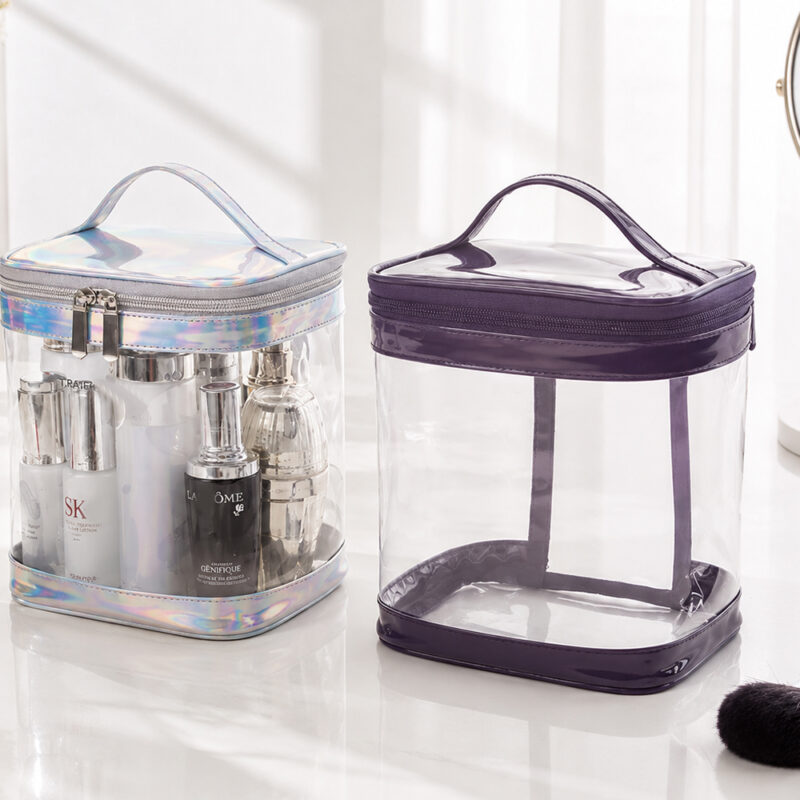
Une trousse de maquillage en PVC personnalisée est une pochette à cosmétiques découpée dans du plastique transparent., givré, or colored polyvinyl chloride film — typically 0.15mm to 0.5mm thick — and assembled by high-frequency welding or stitching. Beauty brands choose PVC over PU, EVA, cotton, or Tyvek when transparency, a wipeable surface, and low per-unit cost matter more than a plastic-free label. Three variables decide whether a bag order looks premium or looks promotional: film gauge, closure hardware, and the printing method used for the logo. This guide breaks down each variable with size charts, closure comparisons, and branding options, plus the scenarios where PVC is not the right material.
What Sizes Do Custom PVC Makeup Bags Come In?
Five size categories cover most retail, voyage, and GWP (gift-with-purchase) orders. Film gauge and dimensions move together — larger bags need thicker film to hold their shape without sagging.
| Size Category | Typical Dimensions | Idéal pour | Common Film Gauge |
|---|---|---|---|
| Mini pouch | 15 × 10 × 5 cm | Lipstick, single brush, sample kit | 0.15–0.20mm |
| Standard organizer | 20 × 15 × 8 cm | Daily makeup, subscription box, GWP kits | 0.20–0,30mm |
| Large travel case | 26 × 20 × 10 cm | Full toiletry kit, salon storage | 0.30–0.40mm |
| TSA quart bag | Environ. 20 × 18 cm, 1L capacity | Carry-on liquids | 0.15–0,25 mm (must stay foldable) |
| Makeup artist kit | 30cm+, multi-compartment | Backstage kits, professional MUA use | 0.40–0.50mm reinforced |
TSA’s 3-1-1 rule requires one quart-sized, clear, zip-top bag per passenger for carry-on liquids, which is why quart bags stay thin rather than heavy-gauge — a rigid 0.5mm film won’t fold flat for the security bin. Makeup artist kits sit at the opposite end: thicker film and welded seams keep the bag structured when packed with brushes, palettes, and tools daily for months.
Which Closure Type Fits a Cosmetics Bag — Zipper, Snap, or Drawstring?
Zipper closures cover roughly 80% of commercial cosmetic bag orders because they seal the bag fully and support branded pullers. Snap and drawstring closures cost less but trade away security and airtightness.
| Fermeture | Security | Cost Impact | Meilleur cas d'utilisation | Limitation |
|---|---|---|---|---|
| Nylon coil zipper (#3/#5) | Haut | Faible à moyen | Daily makeup bags, GWP kits | Coil can jam on heavier PVC gauge |
| Resin zipper | Haut | Moyen | Colorful or branded zipper pulls | Adds weight, higher unit cost |
| Metal zipper (YKK-style) | Le plus haut | Haut | Premium and private-label lines | Cost-prohibitive under 1,000 unités |
| Snap closure | Moyen | Faible | Flat pouches, small kits | Not airtight, weaker for liquids |
| Drawstring | Faible à moyen | Faible | Gift bags, sample giveaways | Not TSA-compliant, no full seal |
| Heat-sealed flap | Faible | Le plus bas | Single-use sample bags | Not reusable once opened |
Nylon coil zippers with a custom-molded puller are the default for a bag meant to be reused daily. Metal zippers make sense only above roughly 1,000-unit orders, since tooling and hardware cost outweigh the benefit on small runs.
How Is a Logo Applied to Clear or Colored PVC?
Silk-screen printing remains the most durable option for one- to three-color logos on PVC film, holding up for the practical life of the bag without peeling under normal folding. UV printing and hot-stamp foil extend the palette but each carries a specific tradeoff in cost or surface compatibility.
| Méthode | Durability | Coût | Idéal pour | Limitation |
|---|---|---|---|---|
| Silk-screen printing | Haut | Faible à moyen | Bold 1–3 color logos | Spot colors only, not photographic art |
| UV printing | Haut | Moyen | Full-color, gradient logos | Needs a flat panel, higher setup cost |
| Heat transfer | Moyen | Faible | Petites courses, sample orders | Can lift after 12–18 months of flexing |
| Hot-stamp foil | Haut | Medium–High | Metallic gold/silver accents | Poor adhesion on curved or textured PVC |
| Woven label patch | Le plus haut | Moyen | Premium retail positioning | Stitching step conflicts with fully welded seams |
A brand printing directly onto welded, seamless PVC should avoid woven labels, since stitching a patch onto a heat-sealed bag punctures the waterproof seam.
PVC vs TPU vs EVA: Which Material Fits the Brand?
PVC remains the lowest-cost clear film of the three and delivers the glossiest, most glass-like transparency. TPU costs more but is phthalate-free and holds a soft, rubbery texture that reads as premium; EVA sits in the middle with a matte, semi-opaque finish.
| Matériel | Transparence | Relative Cost | Eco Profile | Texture | Typical Positioning |
|---|---|---|---|---|---|
| PVC | Le plus haut, glass-like | Le plus bas | Not compostable, chlorine-based | Rigide, brillant | Mass-market, promotional, GWP |
| TPU | Haut, can be frosted | Le plus haut | Phthalate-free, recyclable in some streams | Doux, caoutchouteux | Prime, private-label |
| EVA | Moyen, semi-opaque | Moyen | Recyclable, PVC-free | Mat, spongy | Mid-tier, eco-conscious brands |
A subscription box or promotional GWP program rarely needs TPU’s premium texture; PVC covers that use case at lower cost per unit. A brand launching a flagship product line, by contrast, often upgrades to TPU or EVA specifically to avoid the word “PVC” on ingredient-adjacent packaging copy.
What MOQ and Lead Time Should a Beauty Brand Expect?
Most PVC makeup bag factories set a minimum order quantity between 500 et 1,000 pièces par conception, and that MOQ typically applies per color or per print combination, not per overall order. Sampling takes 5–10 business days, and bulk production runs 15–30 days after sample approval depending on order size and print complexity.
- Échantillonnage: 5–10 business days for a physical pre-production sample
- Production en vrac: 15–30 days from approved sample to finished goods
- Sea freight from South China ports: 25–40 days to US/EU ports
- Air freight: 5–10 jours, at a higher per-unit shipping cost
A brand ordering fewer than 500 units per design should expect a higher per-unit price or a stock/blank bag with add-on printing, rather than a fully custom mold and color run.
When Is PVC the Wrong Choice for a Makeup Bag?
PVC is not the right material in three specific scenarios. First, brands marketing as plastic-free or PVC-free should not use it, since PVC is chlorine-based and cannot carry that claim regardless of thickness or clarity. Second, products sold into regions restricting phthalate content in flexible plastics — the EU under REACH, for example — need documented phthalate-free film, which points toward TPU rather than standard PVC. Third, a bag meant to survive daily heavy use past 12–18 months is a poor fit, because PVC film can crack, yellow, or stiffen with repeated folding and UV exposure. Brands targeting “clean beauty” retail shelves or plastic-reduction commitments should default to TPU, EVA, cotton canvas, or RPET instead.
How Should a Brand Vet a PVC Makeup Bag Manufacturer?
- Request a physical pre-production sample rather than a digital mockup, to test the zipper pull and seam strength by hand
- Confirm REACH and RoHS test reports for the specific PVC film batch, not a generic factory-wide certificate
- Ask for film gauge in millimeters — “durable” ou “thick” is not a specification
- Clarify whether seams are high-frequency welded (waterproof) or stitched (not waterproof)
- Check whether the quoted MOQ applies per style or per color/print combination, since the two change total order cost significantly
FAQ
What is the difference between a PVC makeup bag and a TPU makeup bag?
PVC is cheaper and glossier, while TPU is phthalate-free and has a softer, matte-frosted feel. PVC film runs roughly 0.15–0.5mm and starts cracking or yellowing after prolonged UV exposure and repeated folding, whereas TPU holds up longer under daily flexing. Brands avoiding “PVC” on packaging for clean-beauty positioning typically move to TPU despite the higher per-unit cost.
What is the minimum order quantity for custom PVC makeup bags?
Most factories set MOQ at 500 à 1,000 pièces par conception, and that minimum usually applies per color or print combination rather than per total order. A brand wanting three colorways of the same bag should expect the factory to require 500–1,000 units of each color, not 500–1,000 units split across all three. Commandes sous 500 units are typically filled with stock/blank bags plus add-on printing instead of a fully custom mold.
Can a PVC makeup bag go through TSA airport security?
Oui, if it’s a clear, zip-top bag sized to roughly one quart (about 1 liter), it satisfies TSA’s 3-1-1 rule for carry-on liquids. Compliant bags are typically produced around 20cm × 18cm in a thinner 0.15–0.25mm gauge so the bag folds flat for the security bin. A frosted or colored PVC bag, or one exceeding quart capacity, does not meet the same requirement even if it has a zipper closure.
How long does a custom PVC makeup bag order take from sample to delivery?
A sample typically takes 5–10 business days, and bulk production adds another 15–30 days after sample approval. Shipping adds 25–40 days by sea freight from South China ports or 5–10 days by air at a higher cost per unit. A realistic total timeline from first sample request to goods on hand runs 6–10 weeks depending on freight method.
Which printing method lasts longest on a clear PVC makeup bag?
Silk-screen printing and woven label patches hold up longest, while heat transfer is the least durable of the common methods. Silk-screen ink bonds directly to the PVC surface and typically doesn’t peel under normal folding, whereas heat-transfer logos can start lifting after 12–18 months of daily flexing. Woven labels last even longer but require stitching, which is not compatible with a fully welded, waterproof seam.