 (+035) 527-1710-70
 google@gmail.com
 Elige una dirección

¿Cuánto cuesta una bolsa de embalaje de plástico personalizada? 2026?
Custom plastic packaging bags cost between $0.02 y $0.40 per piece for PVC, EVA, educación física, and PP, while TPU bags run $0.30 a $1.20 por pieza. Commodity resin pellets like PVC and PP sit in the $650-1,200 per ton range in 2026, while TPU resin runs into engineering-resin territory at far higher price points. Five variables set the final number on any quote: raw material, espesor, printing method, hardware (zipper/slider/hang hole), and order quantity. Brand name and country of the factory matter far less than these five inputs.
What Determines the Price of a Custom Plastic Packaging Bag?
Material accounts for 35-50% of a finished bag’s cost, more than size in most cases under 12×16 inches. A bag made from TPU film costs three to eight times more per kilogram of raw material than the same bag made from PE or PP, so switching material can move the unit price further than doubling the bag’s dimensions.
Does Material Choice Change Cost More Than Size Does?
Sí, below a certain size threshold. Once a bag exceeds roughly A4 dimensions, film area starts to dominate the material-cost calculation and size catches up to material as the primary driver.
How Much Does Thickness (Gauge/Mil) Add to Unit Price?
Every 0.02mm (about 0.8 mil) of added thickness raises material weight per bag by roughly 10-15%, which flows almost directly into unit price since resin is priced by the kilogram, not by the piece. A 0.15mm PVC zipper pouch and a 0.25mm version of the identical footprint typically differ by $0.02-$0.05 per piece at the same print and MOQ.
Gravure vs. Screen vs. Digital Printing — Which Costs More?
Gravure printing costs more upfront but less per piece at volume, because it requires an engraved cylinder that typically runs $150-$500 per color but drops printing cost to fractions of a cent per bag past 10,000 piezas. Screen printing needs a cheaper plate ($20-$80 per color) and suits runs under 5,000 piezas. Digital printing has no plate cost at all, which makes it the only economical option below 500-1,000 piezas, but its per-piece ink cost is 3-5x higher than gravure at scale.
How Does MOQ Change Your Per-Piece Price?
Tooling and setup costs get divided across the order, so fixed costs dominate small runs. A $500 tooling cost is roughly $0.80 per unit at 1,000 pieces but drops to $0.08 per unit at 10,000 pieces — the same math applies to plate charges on printed plastic bags, not just rigid boxes.
How Much Does a PVC Bag Cost Per Piece?
PVC bags cost $0.05-$0.35 per piece for standard zipper pouches and flat bags under 12×16 inches at MOQs of 1,000-5,000 piezas. PVC resin trades around $650-900 per ton globally, making it one of the cheapest commodity resins available, alongside PET. PVC is not recommended for bags that contact food directly, since it commonly requires plasticizer additives that food-contact regulations restrict; EVA or PE is the better substitute for that use case.
How Much Does an EVA Bag Cost Per Piece?
EVA bags run $0.08-$0.40 por pieza, roughly 20-40% above equivalent PVC bags at the same thickness. Packaging-grade EVA film specifically manufactured for bag use trades around $2.80-$2.90 per kilogram in ton-lot orders, higher than PVC or PE resin but well below TPU. EVA is the standard swap-in when a brand needs PVC’s clarity and softness but also needs food-contact or phthalate-free compliance.
How Much Does a TPU Bag Cost Per Piece?
TPU bags cost $0.30-$1.20 por pieza, making TPU the most expensive material in this comparison by a wide margin. Standard TPU resin runs $8-15 per kilogram and high-end grades reach $15-25 per kilogram, and even bulk-order TPU rarely drops below roughly $1.10-4 per kilogram — five to twenty times PVC or PE resin cost. TPU is only worth this premium for waterproof phone pouches, dry bags, and applications needing welded (not just heat-sealed) seams and abrasion resistance; it’s overkill for standard jewelry or cosmetic packaging.
How Much Does a PE Bag Cost Per Piece?
PE bags are the cheapest option, ranging $0.02-$0.15 per piece for flat poly bags and mailers. Basic printed PE poly bags can price as low as $0.01-$0.09 per piece at 10,000-piece MOQ from Chinese factories, and LDPE/LLDPE resin trades around $1,000-1,300 per ton, slightly above PVC and PP but still commodity-tier. PE is the default for shipping bags, produce bags, and any application where clarity and premium finish don’t matter.
How Much Does a PP Bag Cost Per Piece?
PP bags cost $0.02-$0.20 por pieza, close to PE pricing since PP resin runs $900-1,200 per ton, roughly comparable to PVC and below PE. OPP (oriented PP) film, common for self-adhesive garment bags, adds a small premium for the stretching process but stays within the same finished-price band. PP suits woven sacks, self-adhesive OPP bags, and applications needing higher tensile strength than PE at a similar cost.
PVC versus. EVA contra. TPU vs. educación física frente a. PÁGINAS: 2026 Cost Comparison Table
| Material | Resin Cost/kg | Finished Bag Price/pc | Mejor para | Not Suitable For |
|---|---|---|---|---|
| CLORURO DE POLIVINILO | ~$0.65-0.90 | $0.05-$0.35 | Joyas, cosmético, bolsas al por menor | Direct food contact |
| EVA | ~$1.20-2.90 | $0.08-$0.40 | adyacente a la comida, phthalate-free needs | Ultra-low-budget bulk runs |
| TPU | ~$2-25 | $0.30-$1.20 | Waterproof phone bags, dry bags | Standard low-cost retail packaging |
| educación física | ~$1.00-1.30 | $0.02-$0.15 | Mailers, envío, produce bags | High-clarity premium display |
| PÁGINAS | ~$0.90-1.20 | $0.02-$0.20 | Sacos tejidos, OPP garment bags | Soft-touch or high-elasticity uses |
Which Material Gives the Best Value for Your Budget?
PE and PP win on raw cost-per-piece; PVC and EVA win on clarity and print finish per dollar spent; TPU wins only on waterproof durability. A brand selling $5-$15 retail jewelry doesn’t need TPU’s $0.30+ floor price when a $0.10 PVC or EVA zipper pouch achieves the same shelf appeal.
When Should You Pay More for TPU or EVA Instead of PVC/PE/PP?
Pay the TPU premium only when the product must survive water immersion or heavy abrasion — mobile phone waterproof pouches are the clearest use case. Pay the EVA premium when a regulator, retailer, or customer specifically requires phthalate-free or food-contact-compliant film; otherwise PVC’s lower cost makes it the more efficient choice for non-food retail packaging.
What Else Gets Added to Your Final Quote Besides the Bag Itself?
Do Zippers, Deslizadores, and Hang Holes Cost Extra?
Sí. A basic press-to-close zipper adds roughly $0.005-$0.02 por pieza; a slider zipper adds $0.01-$0.04; a metal eyelet or hang hole adds $0.005-$0.015. These are itemized separately on most factory quotes rather than folded into the base material price.
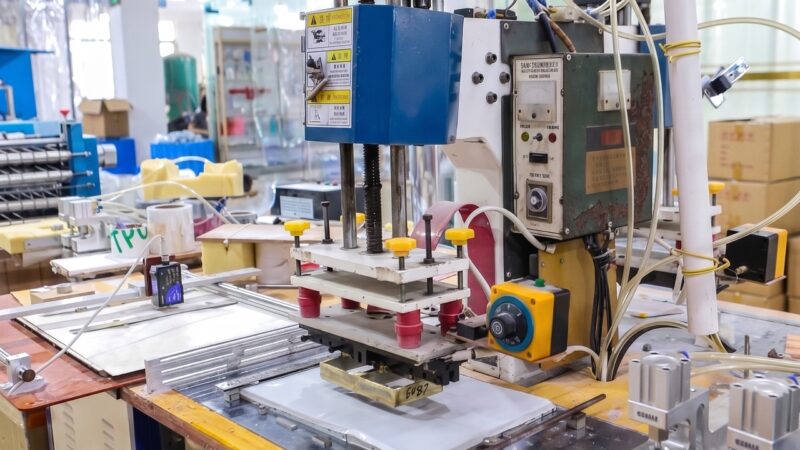
Custom-Plastic-Bag-Hardware-and-Tooling
How Much Do Freight and Customs Duty Add to Landed Cost?
Sea freight from a Guangdong factory typically adds $0.005-$0.02 per piece on container-load orders, while air freight can add $0.05-$0.20 per piece on small urgent orders — often more than the bag itself costs. Import duty varies by destination-country tariff classification and is separate from freight.
How Do You Get an Accurate Custom Plastic Bag Quote?
Send the factory five details up front: material (PVC/EVA/TPU/PE/PP), exact size and thickness, print colors and method preference, closure/hardware type, and target MOQ. Guangdong Minghe embalaje industrial Co., Limitado. runs its own vertical chain — raw material compounding, película soplada, impresión, and bag-making under one roof — which is why quotes can be turned around against in-stock film rather than a fresh production run, shortening lead time on standard sizes.
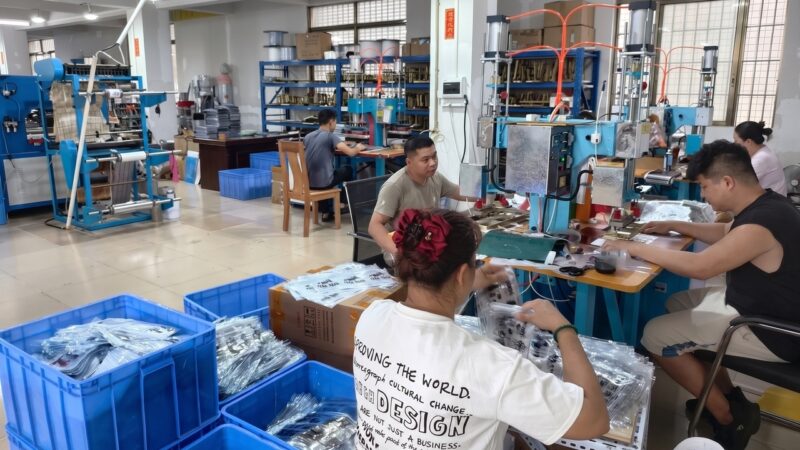
Minghe-Packing-Custom-Plastic-Bag-Sampling Room
Preguntas frecuentes
Q1: Why is a custom TPU bag so much more expensive than a PVC or PE bag of the same size?
TPU bags cost more because TPU resin itself is priced far above commodity resins, not because of extra labor. Standard TPU resin runs roughly $8-15 per kilogram compared to PVC’s $0.65-0.90 per kilogram, a gap of ten times or more. That raw-material difference alone accounts for most of the $0.20-$0.80 price gap seen on finished bags. Unless a product needs TPU’s waterproof, welded-seam durability, PVC or EVA delivers a similar look for a fraction of the cost.
Q2: What’s the cheapest plastic material for custom packaging bags in bulk?
PE and PP are consistently the cheapest options for bulk custom bags. Basic printed PE poly bags can price as low as $0.01-$0.09 per piece at 10,000-piece MOQ, and PP resin trades in a similar $900-1,200 per ton range. PVC comes in close behind at $0.65-0.90 per kilogram resin cost. EVA and TPU cost more per kilogram and aren’t the right pick when unit cost is the primary constraint.
Q3: Should I choose PVC or EVA for cosmetic and jewelry packaging bags?
Choose PVC for lowest cost and choose EVA only if food-contact or phthalate-free compliance is required. PVC bags run $0.05-$0.35 per piece versus $0.08-$0.40 for EVA at the same size and thickness, a 20-40% premium. Neither material is appropriate if the bag will hold food directly — EVA is the safer of the two but PVC should be avoided for that use case entirely. For jewelry and non-food cosmetics, PVC’s lower cost makes it the more efficient default.
Q4: How much does MOQ actually affect the price per piece on custom plastic bags?
MOQ affects price substantially because tooling and setup costs are fixed regardless of order size. A $500 printing plate cost works out to about $0.80 per unit at 1,000 pieces but only $0.08 per unit at 10,000 pieces — a tenfold difference driven entirely by volume. This is why small test orders under 1,000 pieces often look disproportionately expensive compared to production-scale reorders. Requesting price breaks at 1,000 / 5,000 / 10,000 tiers on any quote reveals where the fixed-cost curve flattens.
Q5: Is a waterproof TPU phone bag worth the extra cost compared to a regular PE or PVC pouch?
It’s worth it only if the bag needs actual water submersion resistance, not just splash resistance. TPU film’s welded seams and $8-25 per kilogram resin grade are built for water sealing, while PVC and PE heat-sealed pouches at $0.05-$0.35 per piece are not rated for submersion. For dry retail goods like jewelry or cosmetics, paying TPU’s $0.30+ floor price adds cost without adding functional benefit. Reserve TPU for phone pouches, dry bags, and marine/outdoor use cases specifically.